Wirth Abigail
The theoretical and emotional foundation of Abigail Wirth's work originates from the everyday reality of neurodivergent existence. In her practice, she primarily examines the possibilities and limitations of self-knowledge and identity, exploring these themes through a visual language that is both universally accessible and open to free interpretation. In contemporary artistic discourse, balancing career and family—particularly motherhood and creative practice—has become an increasingly prominent issue. This represents not only practical and financial difficulties, but also a profound psychological and ethical dilemma. Wirth’s narrative ceramics critically reflect on these questions while examining the subtle shifts in emotional states and personal experiences.
In her previous series, the form of the objects echoed Polly Pocket toys from the 1990s: compact cases concealing miniature domestic interiors where dolls performed stereotypical female tasks. With this reference, Wirth pointed to the early internalization of gender roles, as well as the isolation and monotonous everyday lives of stay-at-home mothers.
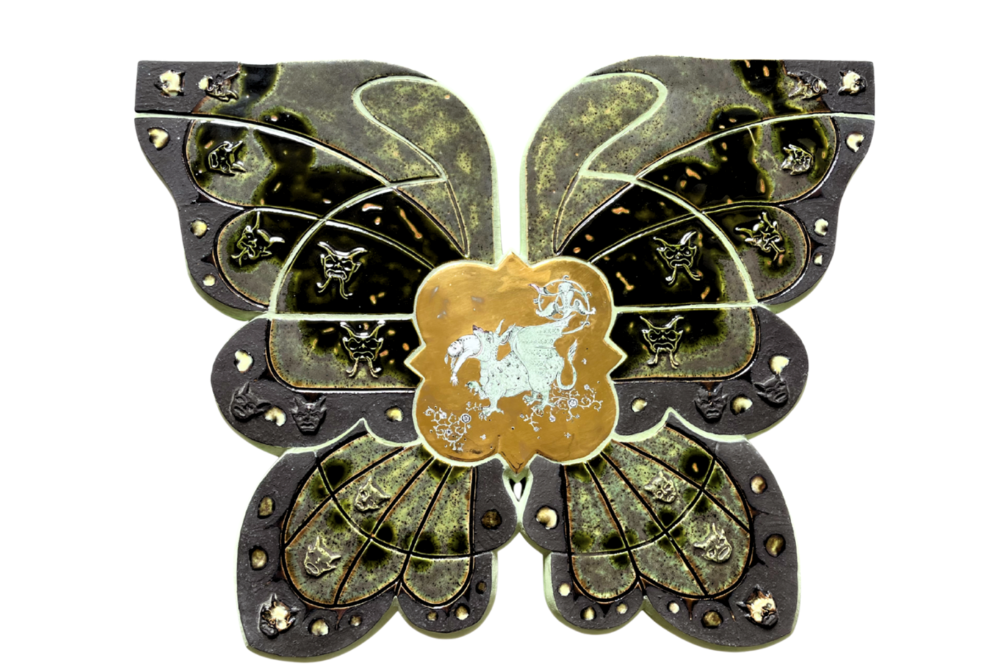
In her latest works, the motif of change takes center stage; these pieces are characterized by a vibrant palette and an exploration of new forms. Small, relief-sculpted heads—ranging from serene to angry expressions—appear across the surfaces of butterfly silhouettes, as if forming the scales of a butterfly wing. In the center, small-scale narrative scenes inspired by medieval illuminations, gargoyles, and mystical imagery capture specific emotional states, while the surrounding surfaces trace the gradual transformation of feelings—such as the slow loss of patience. Alongside its conceptual background, Wirth’s practice is defined by art-historical iconography and conscious composition. Her works draw on medieval and Renaissance visual traditions, deploying motifs of saints and mythical creatures. These references lend intimacy to the pieces, placing them within a broader historical context. By combining precise structures with emotional content, Wirth responds to 21st-century visual and social stereotypes, offering a nuanced picture of their inherent tensions and underlying anxieties.
Wirth graduated in 2024 with a specialization in Ceramics from the Moholy-Nagy University of Art and Design, having previously studied painting at the Hungarian University of Fine Arts. Following her first solo exhibition at am projects, she joined the roster of Molnár Ani Gallery in 2024.
Call of the Void (2026)
-
Description: Glazed ceramic, overglaze decorative painting (gold); mounted on MDF board, grouted
-
Dimensions: 53 x 68 cm; approx. 12 kg
The artwork is part of a series consisting of monumental ceramic-based pieces. Through the motif of the butterfly, this large-scale body of work examines the processes of internal, emotional transformation.
The butterfly—as a symbol of transformation, fragility, and metamorphosis—serves simultaneously as formal inspiration and thematic vehicle. The form is compelling not only in an allegorical sense, but also as a structural and compositional frame within which the artist explores various surface treatments, color relationships, and narrative dynamics.
The mosaic-like construction, the pronounced presence of reliefs, and the painterly surface treatment evoke historical techniques and contemporary visual languages all at once. The butterfly motif appears not as a decorative element, but as a symbolic system that charts the evolution of emotional states—such as patience, impatience, and internal tensions. While the wing surfaces feature more ornamental or abstract solutions, the central figurative scenes build an internal mythological system that organically integrates into the broader network of meaning across the entire work.