
TAW Galéria
TAW Gallery is the Budapest exhibition space of Tokaj Art Wine. Its program is shaped by the connection between the capital gallery and the Tállya artists' residency: in addition to presenting artworks, it offers a space for the creative process and personal professional dialogue. Its exhibitions feature Hungarian and international artists spanning various generations and mediums. It treats contemporary art not as an ivory tower, but as a part of everyday culture; this approach is reinforced by talks held alongside exhibitions, collector programs, and the presence of Tokaj-Hegyalja wine culture.
Borderlines
Where does a functional object end and a work of art begin? Is there a need for this dividing line at all?
Connecting to the design-oriented vision of Budapest Contemporary, TAW Gallery’s booth juxtaposes artistic positions that do not conform to the rules of a single genre. The selection examines how the meaning of an object transforms when function, material, and artistic thought are inseparable from one another. Here, crossing boundaries occurs not only between genres, but also touches upon the conventional frameworks of artistic roles, authorship, and collaboration.
Simon Holpert’s ceramics retain the basic structure of a vessel and a vase, yet they are not limited to utility. Their forms, surfaces, and glazes grant them a sculptural presence: while they can belong in a living space, they do not function merely as everyday objects.
In Miklós Kiss’s practice, the domains of graphic design, product design, installation, and fine art are inherently fluid. For him, the visual systems of mass communication and consumer culture are not only formal sources, but also subjects of inquiry. His works leverage the directness and appeal of design while questioning how we read images, objects, and signs.
Judit Bodrogi employs embroidery—traditionally associated with women’s domestic labor and decorative arts—as a drawing medium. Rather than “elevating embroidery to the status of fine art,” her works challenge this hierarchy itself: why have certain materials and techniques long been viewed as less significant, and to what extent was this determined by their categorization primarily as women’s work?
Luca Fülöp’s practice similarly operates on the threshold between fine art and design, bringing together paintings, prints, watercolors, and design objects. In her work—much like Simon Holpert’s—intimacy and touch take center stage, alongside themes of corporeality and sexuality. These distinct genres are unified by a sensitive, personal visual world.
Dániel Labrosse continuously moves between autonomous fine art and applied visual culture as a painter, illustrator, and animator. His career is marked by collaborations in music, fashion, and branding; at the fair, the results of his currently ongoing collaboration will make their debut.
The featured works do not dissolve genre boundaries; rather, they illuminate the value judgments and ingrained assumptions that sustain them. A functional object, embroidery, the visual language of consumer culture, or a material resulting from a collaboration highlight that every category is an artificial construct—one we impose unnecessarily on the objects around us.
-
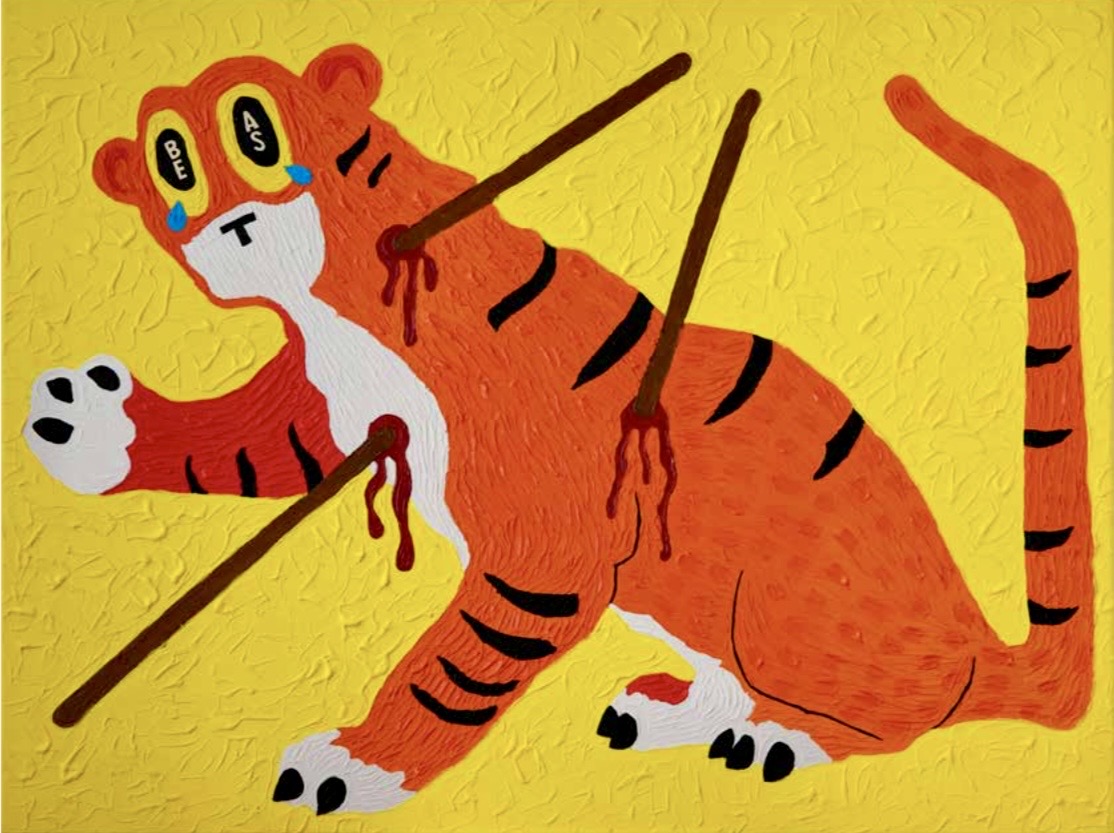
- Kiss Miklós

