Anna Sibitka
At the center of Anna Sibitka’s painting practice are questions of identity, gender roles, and visual self-representation. Figurativity plays a defining role in her work: her paintings originate from personal experiences and internal states, while simultaneously examining universal sensations and social experiences tied to the uncertainties, performativity, and visibility of contemporary womanhood. In her works, the female body appears not merely as a depicted element, but as a visual surface that simultaneously embodies vulnerability, self-defense, and conscious self-reflection.
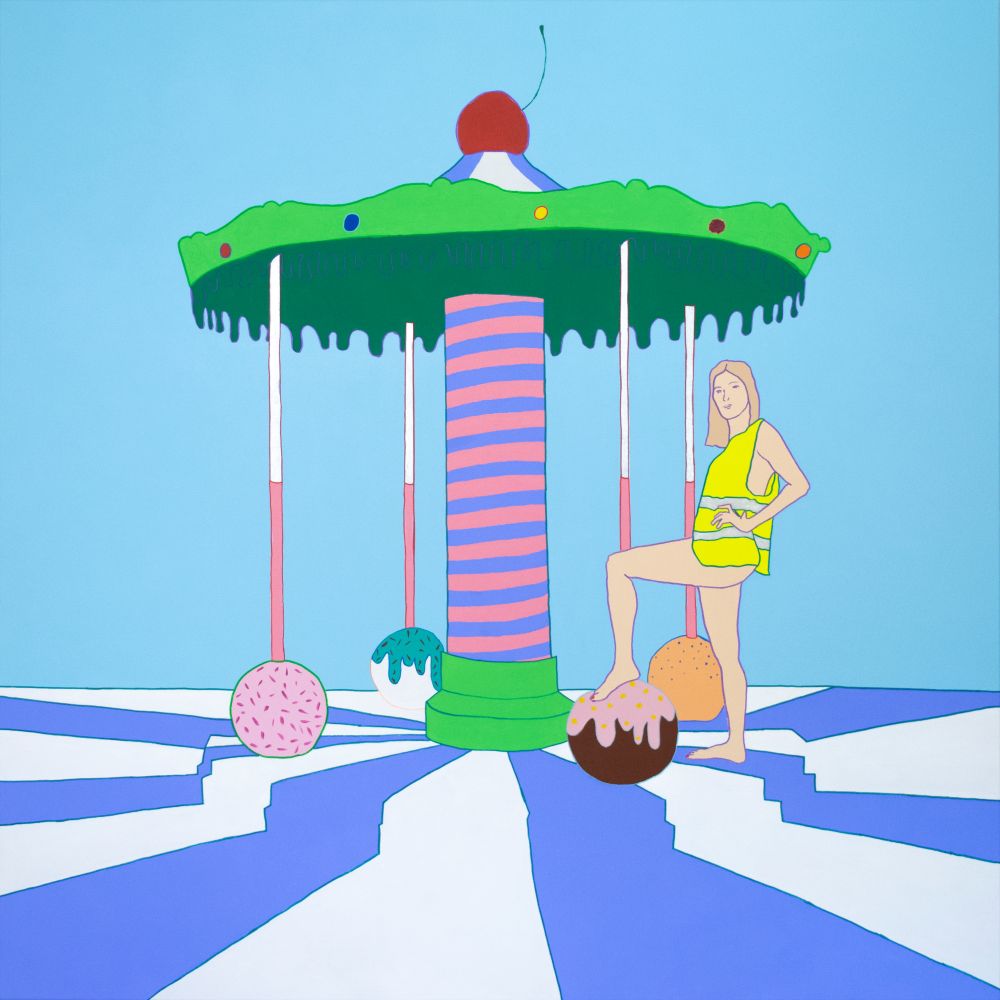
In the series titled Maraschino Cherry (Koktélcseresznye), questions of female identity, self-representation, and the role of the female artist emerge through a personal yet universal visual language. The central figure of the works attempts to be present and to disappear at the same time: demanding attention while confronting her own vulnerability and the societal gaze projected upon her. The series is an examination of that internal state when a female creator tries to find her place in the artistic and social space, while constantly reflecting on how she becomes visible as a woman and as an artist.
In her previous series, Anna Sibitka sought symbols of self-identity through interior spaces and everyday objects; her paintings translated personal questions into the context of happiness, intimacy, and a timeless, idealized state. The Maraschino Cherry series carries this personal inquiry further, turning more emphatically toward questions of the body, female roles, and self-representation.
A recurring motif of the series is the high-visibility reflective vest, which fundamentally serves the functions of safety, protection, and noticeability. On the canvases, however, this object acquires a paradoxical meaning: while drawing attention to itself, it offers no real protection. Appearing alongside the nude female body, the vest becomes a symbol of both visibility and vulnerability. The figure remains in pose, maintaining a role, even when her situation is visibly uncomfortable or fragile. This tension runs throughout the entire series.
On the large-scale panel paintings, proportions shift in a playful manner. The figure in the reflective vest is surrounded by floating, oversized donuts, ice creams, and the title-giving maraschino cherries, which function simultaneously as decorative elements, childhood memories, and fictitious companions. The visual world of the works is built from an "upbeat" color palette, the aesthetics of popular culture, and associations with the material world of childhood, counterbalanced by the presence of the adult nude female body. Highlighted with glitter, the pastel-colored visual space seems lighthearted and playful at first glance, yet tension and self-examination remain continuously present within the compositions.
The images float in an outlined, spaceless, and timeless environment. Small story fragments and delicately structured compositions appear within them, providing the viewer with just enough information to activate their own associations and questions. The female figure does not always look back at the observer, yet in every composition, she is aware of the gaze directed at her. One of the central questions of the series is precisely this: how to be present as a woman and an artist in a visual culture where the female body simultaneously becomes representation, a surface for projection, and a performative role.
The title Maraschino Cherry reflects ironically on this duality. A maraschino cherry is an eye-catching, decorative, and artificial element—a small garnish that is visually prominent, yet easily reduced to a mere aesthetic function. Through this, the title also references the cultural representation of female presence: a condition where visibility does not necessarily equate to genuine attention or understanding.
The series moves on the border between performativity and intimate self-examination. Rather than telling concrete narratives, it captures psychological states: layers of the desire for attention, self-defense, shame, uncertainty, and self-definition. The aim of these works is not to articulate definitive answers, but to make visible the internal conflict that lies between female identity and the creative role.
The entry consists of a series of 7 paintings, each measuring 140 x 140 cm.